











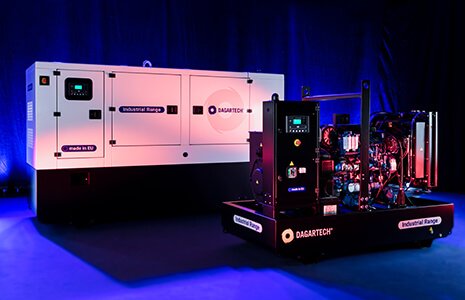



Decisions about running an HVO generator set or sticking with diesel are increasingly common across the power generation industry. The backup and standby power sector is undergoing a significant transformation. Since the European Renewable Energy Directive came into force (RED II, and subsequently RED III), corporate decarbonisation pressure has grown steadily. As a result, one question is appearing more and more frequently on the desks of technical and procurement managers: should we switch to HVO?
HVO — Hydrotreated Vegetable Oil — is presented as a drop-in substitute for conventional diesel. In theory, you could empty the tank, fill it with HVO, and cut your HVO generator set's carbon footprint by half — or even tenfold. In practice, however, the reality is somewhat more nuanced.
This article offers a rigorous technical comparison between HVO and conventional diesel for generator set applications: engine performance, material compatibility, physicochemical properties, environmental impact, regulatory requirements and real costs. Ultimately, the goal is to give you the information you need to make an informed decision.
1. What is HVO? Definition and production process
In technical terms, HVO is a synthetic paraffinic fuel produced by catalytic hydrotreatment of vegetable oils (rapeseed, palm, soybean), animal fats or lipid residues (used cooking oils, food industry waste). Unlike first-generation biodiesel (FAME – Fatty Acid Methyl Esters), HVO does not result from transesterification, but from a hydrogenation reaction at high temperature and pressure that completely removes oxygen from the molecule.
As a result, the product is a hydrocarbon chemically very close to mineral diesel, but with a more homogeneous and pure molecular structure. The industry standardises HVO through the European standard EN 15940 (paraffinic diesel), while conventional diesel complies with standard EN 590.
Raw materials and sustainability hierarchy
In line with the RED III framework (Directive 2023/2413/EU), the RED III framework classifies raw materials for HVO production according to their impact on land use:
| Category | Examples | GHG emission factor |
| Tier 1 – Waste and residues | Used cooking oils (UCO), category 1 & 2 animal fats | Reduction of up to 90% vs fossil diesel |
| Tier 2 – Dedicated crops | Rapeseed, soybean, palm (controversial) | Variable reduction, high ILUC risk |
| Tier 3 – Agricultural residues | Tall oil, wood residues | 60–80% reduction |
Key warning: The carbon footprint of HVO can vary considerably depending on its raw material. HVO produced from non-certified palm oil may have a worse carbon balance than fossil diesel once land-use change emissions are factored in. The ISCC (International Sustainability and Carbon Certification) is a prerequisite for valorising HVO within the European regulatory framework.
2. Physicochemical properties compared
To begin with, the following table summarises the key technical characteristics of HVO100 (pure HVO) and diesel EN 590:
| Property | HVO100 (EN 15940) | Diesel EN 590 | Comment |
| Cetane index | 70 – 99 | 51 – 59 | Better ignition quality with HVO |
| Density at 15 °C (kg/L) | 0.775 – 0.785 | 0.820 – 0.845 | HVO is less dense |
| Lower heating value (MJ/L) | ~34.3 | ~36.0 | Approx. 4–6% difference |
| Sulphur content (mg/kg) | < 5 | < 10 | Slightly cleaner |
| Aromatics content (% vol.) | < 2 | 20 – 30 | Major difference |
| Flash point (°C) | ≥ 55 | ≥ 55 | Equivalent |
| Cold filter plugging point CFPP (°C) | −30 to −25 | −20 to −5 | HVO advantage in cold conditions |
| Storage stability | Excellent (> 12 months) | Good (6–12 months) | HVO advantage |
| Water content (mg/kg) | < 200 | < 200 | Equivalent |
| Kinematic viscosity at 40 °C (mm²/s) | 2.5 – 3.5 | 2.0 – 4.5 | Within normal range |
What these figures mean in practice for an HVO generator set
- The high cetane index of HVO (often above 80) improves ignition quality: shorter ignition delay, more complete combustion, more reliable cold starts and reduced combustion noise. For a generator set used in automatic standby mode, this is a tangible advantage.
- The lower heating value of HVO, on the other hand, means volumetric fuel consumption is approximately 3 to 6% higher to produce the same power output. In practice, a set consuming 10 L/h on diesel will consume around 10.3 to 10.6 L/h on HVO100. Tank range is slightly reduced.
- The low aromatics content reduces the production of PAH (polycyclic aromatic hydrocarbons) and fine particles, resulting in cleaner combustion and less strain on DPF particulate filters.
- The superior storage stability, finally, is a major advantage for standby generator sets, whose fuel can sit in the tank for extended periods without use. Conventional diesel degrades after 6 to 12 months (oxidation, deposit formation, microbial growth); HVO, free from unsaturated fatty acids, is far more stable.
3. HVO generator set compatibility: what you need to know
This is the most frequently misunderstood aspect of the transition to an HVO generator set. HVO is often presented as a universal drop-in fuel. Broadly speaking, this is true — however, there are important caveats.
3.1 Modern diesel engines (Tier 3 / Stage V)
The vast majority of engine manufacturers supplying generator sets with Tier 3 or Stage V engines have validated HVO use in accordance with EN 15940. Manufacturers with official HVO100 approval include:
- Cummins: HVO approval for QSB, QSL, QSM, QSX and B/L/X series engines (application-dependent)
- Volvo Penta: HVO100 approval across the full TWD and TAD industrial range
- Perkins: formal approval on recent engines (consult the technical bulletin applicable to each serial number)
- John Deere Power Systems: approval on PowerTech Stage V engines
Dagartech integrates several of these HVO-approved engine ranges into its Rental Plus EU Stage V range: Volvo Penta, Deutz and Perkins.*
Furthermore, each reference comes with its technical documentation and fuel compatibility confirmation applicable to the relevant model number.
Recommendation: Before converting any generator set to HVO, always request the official fuel approval statement from the engine manufacturer, specific to the model number and year of manufacture. A generic approval "for the range" does not necessarily cover your unit.
3.2 Older engines (Tier 1 / Tier 2 or earlier)
For engines manufactured before 2005–2008, HVO approvals are rare or non-existent. In particular, the following risks have been identified:
- Elastomer compatibility: certain seals and hoses formulated for high-aromatics fuels may contract when exposed to pure paraffinic fuel. This effect is generally minimal but should be verified.
- High-pressure injection systems: older injection pumps and injectors have lubrication tolerances designed for diesel EN 590. HVO has slightly lower lubricity (HFRR < 460 µm per EN 15940), though HVO formulators can add lubricity improver additives.
- Injection timing adjustment: the shorter ignition delay of HVO may slightly shift the optimal combustion point. On engines with fixed mechanical timing, this difference is generally insignificant.
3.3 HVO/diesel blends
HVO and diesel EN 590 are miscible in any proportion. Consequently, in the absence of HVO100 approval, an intermediate blend (HVO30, HVO50) represents a progressive approach that proportionally reduces the carbon footprint without exposing the engine to the theoretical risks of a full substitution on a non-validated engine.
4. Engine performance and emissions
4.1 Power and torque
In generator sets, rated power is defined at the alternator output under standardised conditions (ISO 8528). Notably, comparative tests conducted by several manufacturers and independent research centres (VTT Technical Research Centre of Finland, TNO Netherlands, and AFHYPAC) show:
- Power and torque: statistically insignificant difference between HVO100 and diesel EN 590 on Stage V engines. Measured deviations are below 1%, within the measurement uncertainty margin.
- Specific fuel consumption (g/kWh): slightly lower with HVO on a mass basis, which partially offsets the density difference. On a volumetric basis, HVO consumption is 3 to 6% higher.
- Exhaust temperatures: slightly lower with HVO, which may marginally extend the service life of aftertreatment systems.
4.2 Regulated emissions
| Pollutant | HVO100 vs diesel | Notes |
| NOx | −5 to −10% | Varies by engine and operating point |
| PM (fine particles) | −30 to −50% | Significant reduction due to absence of aromatics |
| HC (unburnt hydrocarbons) | −20 to −30% | More complete combustion |
| CO | −10 to −20% | — |
| CO₂ at exhaust (fossil) | Near-identical | Biogenic CO₂ is not accounted for in the same way |
Important note: The CO₂ reduction achieved with HVO is not visible on an exhaust gas analyser. The CO₂ molecules emitted during combustion are identical regardless of whether they originate from petroleum or a renewable raw material. Instead, the carbon reduction is assessed through life cycle analysis (LCA) using the well-to-wheel or well-to-gate methodology.
4.3 LCA carbon balance
According to European Commission data (JEC Well-to-Wheels study v5, 2020) and RED III default values, the figures break down as follows:
- Fossil diesel (EN 590): ~95 gCO₂eq/MJ (well-to-wheel)
- HVO from UCO (used cooking oils): ~10–15 gCO₂eq/MJ → ~85–90% reduction
- HVO from category 1 animal fats: ~15–20 gCO₂eq/MJ → ~78–84% reduction
- HVO from European rapeseed: ~35–45 gCO₂eq/MJ → ~50–60% reduction
Taken together, these figures explain why the origin of HVO is as strategic as the product itself in the context of a CSR strategy or Scope 1 reporting.
5. Regulatory requirements and certification
5.1 European framework: RED II / RED III
The RED III directive (Directive 2023/2413/EU) is being progressively transposed across Member States. It sets a target of 42.5% renewable energy in the EU's gross final energy consumption by 2030. In this context:
- HVO produced from raw materials listed in Annex IX, Part A of the directive (waste and residues) can be counted twice towards fuel suppliers' blending obligations.
- Companies consuming HVO for their fleet or fixed installations can count this consumption towards their Scope 1 carbon balances, subject to certain traceability conditions (ISCC or RSPO-certified mass balance system).
5.2 ISCC certification and traceability
The ISCC (International Sustainability and Carbon Certification) is the most widely used certification in Europe for attesting to the sustainability and traceability of HVO. It covers:
- The origin and sustainability of the raw material
- Calculation of GHG emission reductions using the RED methodology
- The chain of custody (mass balance, physical segregation or book-and-claim)
Without ISCC certification (or an equivalent recognised by the directive), therefore, you cannot officially count carbon reductions claimed for HVO in regulatory reporting or a GHG Protocol carbon balance.
5.3 EN 15940 standard and ATEX / fire safety compatibility
For ATEX zones or fire safety-constrained installations, you must verify that the flash point of the HVO used meets the site requirements. EN 15940 sets a minimum flash point of 55°C for HVO, identical to that of diesel EN 590, which generally creates no additional constraint.
6. Practical considerations for fleet managers
6.1 Storage infrastructure
HVO is compatible with the majority of existing storage tanks — stainless steel, high-density polyethylene (HDPE) or fibreglass (GRP) — used for diesel. However, copper or unprotected copper alloy tanks are not recommended for any bio-based fuel.
Specific checks to carry out:
- Seal and hose compatibility: check systematically for a first conversion, particularly on installations more than 10 years old.
- Diesel residues: a tank previously used for diesel may contain sediment (microorganisms, sludge) that could contaminate the HVO. Preventive cleaning is recommended before the first HVO delivery.
- Regulatory labelling: owners must relabel tanks in accordance with chemical product regulations (CLP) and local fire safety requirements.
6.2 Preventive maintenance when switching your generator set to HVO
Switching to HVO100 in a generator set previously running on diesel can release carbon deposits from fuel circuits, due to the slightly different solvent properties of paraffinic fuel. As a result, this phenomenon — known as the tank cleaning effect — can clog filters during the first hours of operation.
Recommendations:
- Replace the fuel filter when switching to HVO
- Plan an additional filter check after 50–100 hours of operation
- Keep a spare filter in stock during the transition period
6.3 Start-up tests and monitoring
For sets in standby mode, additionally, we recommend weekly or monthly start-up tests. Monitoring engine parameters — load acceptance time, oil pressure, temperatures — ensures the fuel transition has no effect on the reliability of automatic starts.
7. Economic analysis
7.1 HVO price
HVO remains more expensive than fossil diesel. Across Europe, the price differential varies by market, volume and contract, but is generally between +15% and +40% on the pre-tax price of diesel EN 590 (market data Q1 2024 – Q1 2025). Nevertheless, this premium narrows as production capacity grows, particularly with large refinery conversion projects such as those from Neste, TotalEnergies and Eni Versalis.
7.2 Economic offsetting factors
Several factors can, however, reduce or offset the HVO cost premium:
| Lever | Potential impact |
| Carbon tax reduction / energy contribution | Varies by country and tax regime |
| Valorisation under blending obligation systems | Certificate resale: HBE (Netherlands), RTFC (UK) |
| Avoidance of ETS compliance costs for qualifying installations | Depending on installed capacity threshold |
| Maintenance cost reduction (less soot, less strain on DPF filters) | Estimated at 5–15% over DPF service life |
| CSR / extra-financial reporting value (CSRD) | Difficult to monetise directly |
7.3 Total cost of ownership (TCO)
To illustrate, take a 500 kVA generator set running 500 hours/year at 75% load with a specific consumption of 150 g/kWh:
- Estimated diesel consumption: ~42,000 L/year
- HVO premium at +30%: ~€12,600/year (based on a diesel price of €1.00/L ex-VAT)
- CO₂ reduction (UCO HVO, −85%): ~105 tCO₂eq/year avoided
- Carbon value at €65/tCO₂ (indicative ETS price): ~€6,800/year
Overall, the net marginal cost of the transition in this example would be around €5,800/year, i.e. an abatement cost of approximately €55/tCO₂ avoided — a figure at the lower end of industrial carbon abatement costs.
8. Comparative summary: HVO generator set vs diesel
| Criterion | HVO100 | Diesel EN 590 | Verdict |
| Engine performance | Equivalent | Reference | = |
| Volumetric consumption | +3–6% | Reference | Slightly unfavourable HVO |
| Cold start | Superior | Good | HVO |
| Pollutant emissions (PM, NOx, HC) | Significantly reduced | Reference | HVO |
| LCA carbon balance | −50 to −90% (by origin) | Reference | HVO |
| Storage stability | Excellent | Good | HVO |
| Modern engine compatibility (Stage V) | Very good (with approval) | Universal | ≈ |
| Older engine compatibility | Check case by case | Universal | HVO |
| Existing infrastructure | Compatible with precautions | Reference | ≈ |
| Network availability | Growing | Universal | HVO |
| Fuel cost | +15 to +40% | Reference | Diesel |
| Regulatory value (CSRD, RED III) | High | None | HVO |
9. Dagartech Rental Plus EU Stage V range: HVO generator sets designed from the ground up
At Dagartech, we manufacture generator sets at our factory in La Muela (Zaragoza, Spain). Our Rental Plus range has been specifically designed for machinery rental companies and fleet managers who operate in challenging environments — construction sites, events, critical industries. Crucially, every unit fully complies with EU Stage V regulation (2016/1628/EU) on non-road mobile machinery emissions.
All Rental Plus references come HVO generator set compatible as standard. Each unit carries a Stage V engine. The manufacturer has officially approved it for HVO100 or HVO/diesel blend operation, per the applicable technical bulletins.
Engines available in the Rental Plus range
| Engine | Power range | Dagartech product page |
| Volvo Penta (TAD / TWD) | 250 kVA to 670+ kVA | View Volvo sets → |
| Deutz (TCD) | 30 kVA to 100 kVA | View Deutz sets → |
| Perkins (400J / 1200 Series) | 20 kVA to 250 kVA | View Perkins sets → |
| Cummins (B / L Series) | 100 kVA to 500+ kVA | View Cummins sets → |
Selected references from the range, all EU Stage V compliant:
- DGVR 250 ST – Volvo TAD882GE engine – 250 kVA PRP
- DGVR 400 ST – Volvo TAD1382GE engine – 400 kVA PRP
- DGDR 60 ST – Deutz TCD2.9L4 engine – 54 kVA PRP
- DGDR 40 ST – Deutz TD2.9L4 engine – 39 kVA PRP
Designed for rental and critical environments
Dagartech developed the Rental Plus generator sets with HVO transition operators in mind:
- Tanks and fuel circuits compatible with paraffinic fuels from the factory
- Easy maintenance access for filter checks during the fuel transition period
- Integrated engine monitoring systems for real-time tracking of key parameters (fuel pressure, temperatures)
- Robust in demanding conditions: dust and moisture sealing, reduced noise levels, resistance to construction site vibration
For machinery rental applications, the Rental Plus range is today one of the most complete solutions on the market for operating an HVO generator set without operational friction.
Need a generator set with specific requirements?
If your project calls for specific characteristics — a tank configuration suited to long-term HVO storage, multi-unit coupling, integration into an energy management system or a particular certification — our engineering team will design a fully bespoke solution.
We are here to help you:
- Confirm HVO compatibility for your current generator set model
- Identify the right Rental Plus reference for your power and application
- Support you through the fuel transition process, from technical documentation to preventive maintenance
Visit our technical support section or contact our team directly at +34 976 141 602.
Conclusion
HVO is not a "miracle" fuel that solves every equation in industrial decarbonisation. Nevertheless, it is a high-quality paraffinic fuel with engine performance equivalent to diesel. Its main advantage is a substantial reduction in lifecycle carbon footprint — provided the raw material is certified and traceable.
For recent generator sets (Stage IV / Stage V), the transition to HVO100 or HVO/diesel blends is technically sound and operationally viable. This holds for engines carrying official HVO approval from their manufacturer, with a few precautions during implementation.
The decision to switch to HVO must take into account:
- Verification of engine approval with the manufacturer
- The origin and certification of the HVO procured (priority to ISCC-certified UCO)
- Analysis of the fuel cost premium against the expected regulatory and CSR benefits
- A preventive maintenance plan for the transition
For fleets subject to CSRD, GHG Protocol Scope 1 reporting or internal carbon neutrality policies, HVO is today one of the most accessible levers available. Moreover, it enables significant reductions in direct generator set emissions without major changes to existing infrastructure.
Would you like to know whether your generator set is compatible with HVO? Are you looking for a Stage V solution ready to run on this fuel? Dagartech's technical team is at your disposal. Discover the Rental Plus EU Stage V range or contact us directly for a personalised analysis of your fleet.
* First of all, verify HVO compatibility for your specific engine model.
