











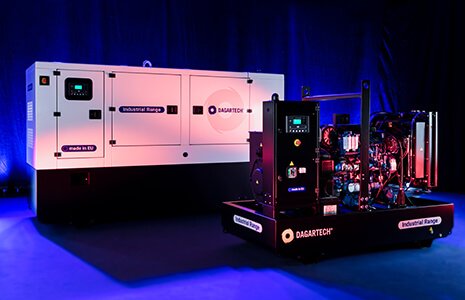



La continuidad del suministro eléctrico es un factor crítico para la mayoría de las empresas. Unexpected outages, micro-cuts, or prolonged voltage drops can result in economic losses, damage to sensitive equipment, or interruptions in key processes. In this context, investing in a generator has become a strategic decision for many organisations. Within this analysis, one of the most frequently consulted power ranges is the 200 kVA generator. Not so much because that figure is an objective in itself, but because it usually sits at the centre of what is considered medium power, a common balance point between capacity, cost, and versatility. Throughout this article, we analyse when it makes sense to invest in a generator of this range and which factors should be evaluated before making the decision.
What is considered a medium-power generator
Although there is no strict regulatory classification, in the industrial sector medium-power generators typically refer to equipment exceeding 30 kVA and remaining below approximately 800 kVA. This range covers a wide variety of applications, from industrial facilities to public buildings or medium-sized critical infrastructures.
Within this interval, the 200 kVA generator frequently appears as a reference in searches and preliminary studies. This is because many installations, as they grow or modernise, reach demand levels approaching that threshold. In any case, the important thing is to consider the nature and size of the loads of the installation to propose the most appropriate option for each case.
Why many companies look for generators around 200 kVA
The high demand for information on 200 kVA generators responds to several practical factors:
- Energy growth steps: many companies evolve from lower power levels and reach a consumption level that can no longer be met with small solutions.
- Conservative sizing: in preliminary studies, there is a tendency to select a power with some safety margin.
However, it is worth emphasising that the power should never be chosen solely based on trends or search volume, but on a real study of loads and operating conditions.
Typical technical characteristics in this power range
Electrical power and types of service
A generator can be considered for different operating modes:
- Standby: for emergency supply in the event of a grid failure.
- Prime: for continuous operation with variable loads or where the generator acts as the main power source.
Fuel consumption and performance
In this power range, fuel consumption is closely linked to load level and engine design. Prolonged operation at very low loads can negatively affect performance and maintenance, making it essential to correctly adjust the rated power to the actual demand.
Architecture and robustness
Medium-power generators incorporate:
- High-performance industrial alternators.
- Advanced control systems for monitoring and protection.
- Chassis and enclosures designed for intensive use, both indoors and outdoors.
These characteristics make them particularly suitable for demanding environments and recurring duty cycles.
Most common business applications
Industry and production processes
In industrial plants and production facilities, a generator close to 200 kVA could ensure the continuity of critical lines, control systems, compressors, or essential machinery, minimising the impact of grid outages.
Corporate buildings and logistics
Logistics centres, technical offices, or corporate buildings with HVAC systems, lighting, and internal servers find in this power range a balanced solution to cover essential services.
Critical infrastructures
In healthcare centres, telecommunications, or small and medium-sized data centres, medium-power generators act as an indispensable backup for systems that cannot tolerate interruptions, always integrated within an overall redundancy strategy.
Real advantages of investing in a generator of this range
Investing in a medium-power generator offers clear benefits when there is a real need:
- Operational continuity in case of supply failures.
- Protection of sensitive equipment against voltage drops.
- Reduction of downtime costs, especially in industrial processes.
- Long service life if the equipment is properly sized and maintained.
In many cases, the return on investment is measured not only in direct savings but in the ability to maintain activity even under adverse conditions.
When a 200 kVA generator is not the best option
Not all companies need a generator of this size. There are situations where this power may be inadequate:
- Oversizing in installations with lower actual consumption.
- Prolonged operation at low load, negatively affecting the engine.
Analysing these alternatives is part of a responsible technical decision.
Key factors before deciding on the investment
Before investing in a medium-power generator, it is essential to consider:
- Detailed study of loads and startup peaks.
- Installation conditions, available space, and acoustic requirements.
- Applicable regulations and environmental requirements.
- Maintenance costs throughout the equipment’s life.
- Comparison between purchase and rental depending on the intended use.
A rigorous evaluation avoids costly mistakes and ensures that the chosen solution is truly suitable.
How to know if this is the right power for your company
The key question is not whether it is worth investing in a 200 kVA generator, but whether this is the power your installation requires and therefore meets its actual needs. Only a complete technical analysis, supported by reliable data, allows for an informed decision.
In this regard, consulting a specialised manufacturer with deep knowledge of industrial applications is essential to ensure an efficient, safe investment aligned with business objectives.
